Showing posts with label Sodium and Potassium. Show all posts

Sunday, July 9, 2017

2.1: Understand How the Similarities in the Reactions of these Elements with Water Provide Evidence for their Recognition as a Family of Elements


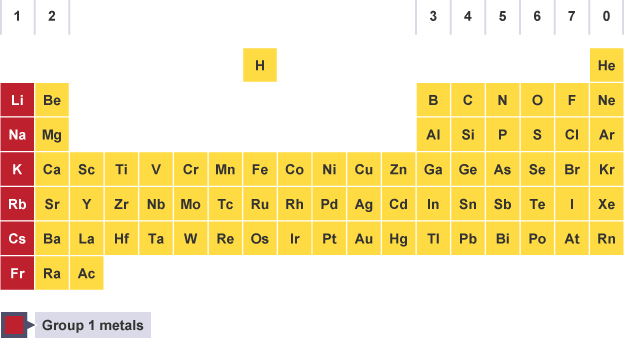
ALKALI  METALS: Group 1 Metals that commonly include Lithium, Sodium and  Potassium


s
SIMILAR REACTIONS WITH WATER:
s
  • Group 1 Metals will react similarly with Water as they are a family of Elements called Alkali Metals
  • They will react vigorously with Water to produce an Alkaline Metal Hydroxide and Hydrogen Gas
s
ELEMENT
REACTION
LITHIUM
  • Bubbles of gas

SODIUM
  • Bubbles of gas
  • Melts into a shiny ball that dashes around the surface

POTASSIUM
  • Bubbles of gas
  • Melts into a shiny ball that dashes around the surface
  • Burns with a lilac-coloured flame

2.2: Understand How the Differences between the Reactions of these Elements with Air and Water Provide Evidence for the Trend in Reactivity in Group 1


ALKALI  METALS: Group 1 Metals that commonly includes Lithium, Sodium and  Potassium

TREND OF REACTIVITY IN GROUP 1 METALS:


  • The reactivity of Group 1 Metals will increase down the Group
  • The reaction of Group 1 Metals with Air and Water becomes more vigorous as you go down the Group

s
REACTION WITH AIR:
s
ELEMENT
REACTION
LITHIUM
  • Burns with a Red flame

SODIUM
  • Burns with a Yellow / Orange flame

POTASSIUM
  • Burns with a Lilac-coloured flame

s
s

REACTION WITH WATER:
s
ELEMENT
REACTION
LITHIUM
  • Bubbles of gas

SODIUM
  • Bubbles of gas
  • Melts into a shiny ball that dashes around the surface

POTASSIUM
  • Bubbles of gas
  • Melts into a shiny ball that dashes around the surface
  • Burns with a Lilac-coloured flame

2.3: Use Knowledge of Trends in Group 1 to Predict the Properties of Other Alkali Metals


ALKALI  METALS: Group 1 Metals that commonly include Lithium, Sodium and  Potassium
s
PROPERTIES OF OTHER ALKALI METALS (RUBIDIUM, CAESIUM AND FRANCIUM):
s
  • As the reactivity of Alkali Metals increases down the Group, Rubidium, Caesium and Francium will react more vigorously with Air and Water
  • Lithium is at the top so will be the least reactive, while Francium is at the bottom so will be the most reactive (Francium is rare and radioactive so is difficult to confirm predict reaction)

PREDICTED REACTION WITH WATER:
s
ELEMENT
REACTION
RUBIDIUM
  • Explodes with sparks
CAESIUM
  • Violent explosion due to rapid production of heat and Hydrogen
FRANCIUM
*Too Reactive*

2.4C: Explain the Trend in Reactivity in Group 1 in Terms of Electronic Configurations


ALKALI  METALS: Group 1 Metals that commonly Include Lithium, Sodium and Potassium
s
ELECTRONIC CONFIGURATION OF THE FIRST THREE ELEMENTS IN GROUP 1:
s


TREND IN REACTIVITY OF GROUP 1:
s
  • Reactivity of Group 1 Metals increases as you go down the Group
  • As each Element has only one Electron on their outer shell, they will react to lose one outer electron to form full outer shell of electrons
  • As you go down Group 1, the number of shells of Electrons increases (period number increases down the periodic table), hence there are weaker electrostatic forces of attraction as the outer electron is further away from the Nucleus
  • Less energy is needed to overcome the electrostatic forces of attraction between the Negatively Charged Electron and the Positively Charged Nucleus
  • As Electrons can therefore be lost more easily, the reactivity of Group 1 Metals increases as you go down the Group